Professional Mold Inspection, Testing & Remediation in Montville, NJ
Call (973) 520-6499 For Same Day Mold Testing in pany in Montville, NJ.
Certified Mold Removal has served Morris County homeowners and businesses since 1995. As OSHA and MICRO certified specialists, we don’t just spray the surface. We use precise moisture mapping to find out exactly where the water is coming from. This ensures the mold is permanently removed and never comes back. We treat your property with the same care and precision we would expect for our own homes. See what our regional clients say about our dedicated, detailed inspections by viewing our verified Google Business Profile reviews.
Why Montville Properties Are Especially Prone to Mold
Every town has its own combination of geography, climate, and construction styles that shape how moisture behaves inside homes. Montville Township presents a particularly challenging set of conditions that makes professional moisture management more important here than in many surrounding communities.
The Local Water Table and River Systems
Montville sits right over the Towaco Valley underground water reservoir. According to data from the New Jersey Geological and Water Survey, during heavy New Jersey storms, this massive subterranean water system fills up fast, pushing the local water table right up against your home’s foundation. This creates intense water pressure (hydrostatic pressure) that literally forces moisture straight through solid concrete basement floors and foundation walls.
Climate and Seasonal Stress on Buildings
Morris County’s humid continental climate delivers hot, humid summers and sharply cold winters — a combination that stresses building envelopes in two distinct ways:
- Summer: High outdoor humidity overloads HVAC systems, causing condensation on cool metal ductwork, supply lines, and concrete surfaces. Inadequate dehumidification in finished basements allows moisture to accumulate inside wall cavities without any visible signs.
- Winter: Warm indoor air migrates toward cold exterior surfaces — window frames, rim joists, and outer wall cavities — where it condenses and creates chronic wetting on organic building materials throughout the heating season.
Montville’s Diverse Housing Stock
The township contains an unusually wide range of architectural ages and styles, from 18th-century Dutch stone farmhouses to mid-century split-levels to large modern ridge-line developments. Older homes frequently have aging foundation waterproofing and original ventilation systems that were never designed to handle modern moisture loads. Many have been updated with tighter insulation and finished lower levels — improvements that can accidentally trap water vapor inside wall cavities that were built to breathe. Newer construction is not immune either; tightly built homes with insufficient fresh-air ventilation accumulate indoor humidity more rapidly.
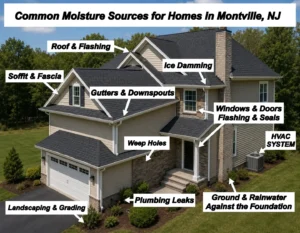
Unchecked roof leaks compromise indoor air quality. Discover how professional mold inspection protects Madison, NJ residences.
Certified Mold Removal Inc. Service Links:
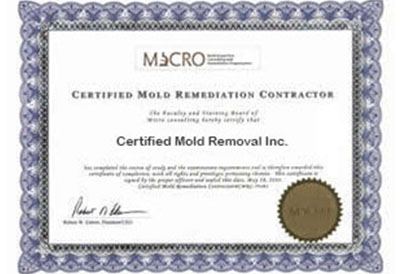
Comprehensive Mold Testing & Inspection Services in Montville, NJ
Our Inspection and Testing Process
Before any physical cleanup begins, an accurate assessment is essential. Surface growth is rarely the full picture — what you can see is almost always a symptom of a larger hidden moisture problem. Our diagnostic process maps the full extent of any issue using three complementary methods.
Moisture Mapping
We use both pin-type and pinless digital meters to measure moisture percentage inside drywall, plaster, and wood framing throughout the affected area. This tells us whether a water source is currently active or a past event, and it defines the true boundaries of any damaged material — critical for scoping an accurate abatement plan.
Thermal Infrared Imaging
Thermal cameras detect subtle surface temperature differences caused by evaporating moisture. This allows us to locate hidden plumbing leaks, missing insulation, and wet wall cavities without opening walls — pinpointing problems in minutes that would otherwise require exploratory demolition.
Independent Air and Surface Sampling
Using calibrated pumps and certified spore-trap cassettes, we collect volumetric air samples from affected and unaffected areas of your home. All samples are analyzed by an independent, accredited laboratory — not an in-house lab — providing unbiased data on species, concentration levels, and whether spores have become airborne. These results guide the scope of work and serve as documentation for insurance claims.
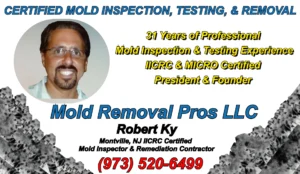
Montville, NJ homeowners rely on Certified Mold Removal for expert mold inspection, testing, and remediation services guided by founder Robert Ky.
How We Approach Mold Remediation
Every abatement project follows the IICRC S520 Standard for Professional Mold Remediation — the industry’s governing protocol for safe and effective fungal contamination cleanup. Our process begins not with cosmetic cleanup, but with the moisture source.
Phase 1 — Source Correction
No abatement will hold long-term if the moisture source remains active. Before disturbing any affected material, we confirm that the underlying cause — whether a plumbing leak, roof penetration, foundation seepage, or ventilation deficiency — has been identified and addressed. In some cases we perform this correction directly; in others we coordinate with licensed plumbers or waterproofing contractors before proceeding.
Phase 2 — Containment and Negative Pressure
We isolate the work area using heavy-duty polyethylene sheeting and negative air pressure machines fitted with HEPA filtration. Negative pressure ensures that any spores disturbed during demolition are drawn into the filtration units rather than escaping into unaffected areas of the building. This containment step is non-negotiable and is frequently skipped by non-specialist contractors — an omission that often results in cross-contamination of clean areas.
Phase 3 — Material Removal and Structural Cleaning
Porous materials that cannot be restored — saturated drywall, insulation, and carpet — are misted lightly before removal to minimize airborne disturbance, then double-bagged and removed from the structure. Non-porous structural components such as wood framing, concrete block, and metal are retained and cleaned thoroughly using HEPA vacuuming followed by hand-scrubbing with approved antimicrobial agents.
Phase 4 — Treatment and Protective Coating
All remaining structural surfaces within the work zone are treated with an EPA-registered antimicrobial solution. Once fully dry, a breathable, mold-resistant encapsulant is applied to structural wood framing in areas of chronic moisture exposure — such as below-grade foundations and crawl spaces — providing a protective barrier against future colonization.
Phase 5 — Clearance Testing
We strongly recommend — and can arrange — independent post-clearance air sampling performed after containment is removed. Clearance testing conducted by a third party provides objective confirmation that spore levels have returned to or below outdoor baseline levels and that the space is safe for reconstruction and re-occupancy.
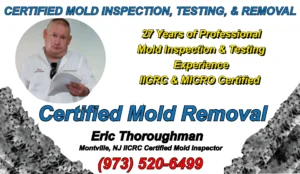
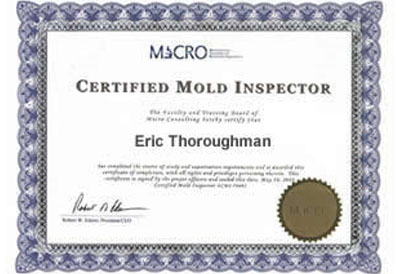
Eric Thoroughman MICRO and IICRC certified mold inspector in Montville NJ with over 27 years of air quality testing and remediation expertise.
Toxic Black Mold Removal Procedures
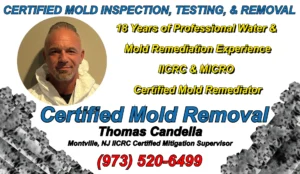
Montville, NJ homeowners trust Thomas Candella of Certified Mold Removal for professional remediation project supervision, and expert mitigation services.
Why Choose Certified Mold Removal for Your Montville Property
Recent Mold Remediation Work in Montville, NJ
The following projects are representative of the work our team carries out in Montville Township and the surrounding Morris County area. Each project began with a full inspection and independent air sampling before any physical work was performed.
Basement Abatement — Montville Township
Groundwater intrusion through an uncoated block foundation wall produced extensive growth behind finished drywall in a lower-level recreation room. Our team removed affected drywall and carpeting, treated the block wall with antimicrobial solution, and encapsulated the foundation before the homeowner proceeded with reconstruction. Post-clearance air sampling confirmed spore levels returned to outdoor baseline within 48 hours of project completion.
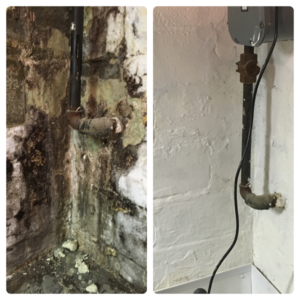
This Montville NJ client failed to run a dehumidifier in his basement but our mold remediation experts cleaned everything up nicely.
Attic Cleanup — Towaco Section of Montville
A blocked soffit vent combined with a bathroom exhaust fan routed into the attic rather than to the exterior had produced widespread dark staining across the roof sheathing. After correcting the ventilation deficiencies, our crew treated the sheathing with HEPA vacuuming, hand-scrubbing, and an antimicrobial encapsulant. The full sheathing was preserved — no replacement was required — saving the homeowner significant reconstruction cost.

Before mold remediation for this Montville, NJ client began, test results showed heavy Aspergillus/Penicillium type growth on the attic sheathing.
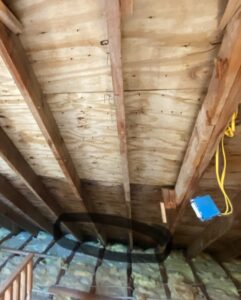
This is how the attic looked after we completed the clients mold remediation project.
Crawl Space Mitigation — Pine Brook Area
An unlined crawl space beneath a mid-century split-level had allowed soil vapor to saturate the floor joists and subfloor above for several seasons. Our team cleaned and treated the structural framing, replaced contaminated insulation, and installed a full-coverage polyethylene vapor barrier. The homeowner reported a noticeable improvement in first-floor air quality within the first week following project completion.
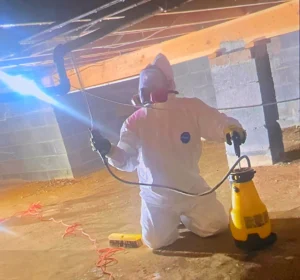
Montville, NJ certified mold remediation technician applies antimicrobial fungicide to floor joists of clients home.
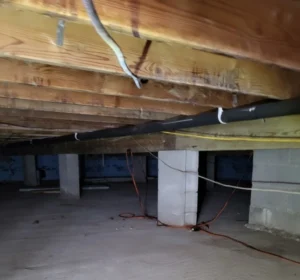
This is what the crawl space ceiling rafters looked like after Certified Mold Removal completed the cleanup.
Why Montville Homeowners Choose Certified Mold Removal
- In continuous operation since 1995 — over 30 years serving Morris County
- IICRC and MICRO certified inspectors and remediation supervisors
- Fully licensed and insured | NJ License #13VH11319800
- Independent laboratory analysis — no in-house lab conflict of interest
- Written scope of work and fixed pricing before any work begins
- Same-day inspection and testing available throughout Montville Township
- Post-clearance testing coordination available upon request
Frequently Asked Questions
Why is mold growth so common in Montville, NJ basements and attics?
Montville’s seasonal climate—characterized by humid New Jersey summers and damp winters—creates prime conditions for mold. Many homes near the Rockaway River or properties with older stone foundations experience high water tables and hydrostatic pressure, forcing moisture into basements and crawl spaces. Without proper mechanical ventilation or dehumidification calibrated for Morris County’s climate, unconditioned spaces quickly develop mold.
How do you collect mold samples during a mold inspection?
We utilize a combination of non-viable air sampling (using calibrated spore traps to measure airborne grain counts per cubic meter) and surface sampling (via sterile swabs or tape lifts). This allows us to compare indoor spore levels against the localized outdoor air baseline in Northern NJ, ensuring we identify hidden reservoirs rather than normal environmental background levels.
Is every type of black mold found in NJ homes toxic?
No. While Stachybotrys chartarum is the infamous ‘toxic black mold’ that produces mycotoxins, many dark molds found in local properties are actually Cladosporium or Alternaria. However, because all mold is an allergen and can compromise indoor air quality, the IICRC S520 standard dictates that any indoor mold growth should be professionally contained and remediated, regardless of the specific species color.