Mold Removal & Remediation in Cresskill, NJ
Call (201) 773-1466 For Same Day Mold Testing in pany in Cresskill, NJ.
Cresskill, New Jersey occupies a geographically distinct and hydrologically complex position in Bergen County. The borough is defined not just by its well-regarded schools and upscale residential character, but by a network of waterways that encircle it on multiple sides . The Tenakill Brook, Demarest Brook, and Cresskill Creek converge in and around the borough. This creates one of the most flood-vulnerable communities in northeastern New Jersey. For property owners here, that geographic reality has direct consequences for indoor air quality and structural integrity. At Certified Mold Removal, we deliver professional mold remediation services grounded in a precise understanding of what makes Cresskill homes and commercial buildings uniquely susceptible to mold growth.
The U.S. Environmental Protection Agency is clear: indoor mold is a documented health hazard, associated with respiratory illness, chronic sinus conditions, and allergic sensitization — particularly dangerous for children, the elderly, and those with compromised immune systems. Mold does not resolve on its own. It expands, deepens, and migrates into adjacent building materials until a qualified mold remediation contractor intervenes with the proper equipment, containment protocols, and post-abatement verification.
Cresskill’s housing units span more than a century of construction. The borough includes traditional Colonial-revival homes dating to the early 1900s, mid-century cape cods and split-levels built during the postwar suburban expansion, and newer large-footprint custom estates. Each era of construction presents it own distinct moisture issues. Older homes commonly lack modern vapor barriers, have aging cast iron or galvanized plumbing, and were built before contemporary standards for crawl space encapsulation existed. Newer large homes, by contrast, introduce complexity through expansive roof lines, multi-zone HVAC systems, and finished basements that create hidden reservoirs for moisture accumulation. With approximately 43% of the borough covered by impervious surfaces — rooftops, driveways, and paved areas — stormwater has limited places to go after heavy rainfall events. As a result it frequently finds its way into foundations, crawl spaces, and basement slabs.
Bergen County’s climate compounds these structural vulnerabilities. New Jersey’s mid-Atlantic climate brings humid summers to Cresskill. Dewpoints regularly stay above 65°F. Powerful nor’easters deliver intense rainfall over short periods, and frequent freeze-thaw cycles damage foundation waterproofing and masonry over time. The National Weather Service records about 46 inches of annual regional precipitation. This water flows toward aging foundations and saturated soils resulting in chronic moisture. All this makes mold remediation a recurring necessity, rather than a one-time fix.
Certified Mold Removal Inc. Service Links:
Mold Inspection and Mold Testing: Precision Diagnostics for Cresskill Properties
The distinction between a surface wipe-down and true professional mold remediation begins with what happens before any physical work takes place. A careful mold inspection identifies not just visible growth but the hidden moisture pathways that cause it. Without locating and addressing the moisture source, any mold remediation activities are temporary as it will simply come back.
Our certified mold inspectors utilize infrared thermal imaging cameras and precision moisture meters to map water intrusion paths inside wall cavities, beneath flooring systems, and above finished ceilings. These tools enable us to avoid destructive investigation methods in areas that don’t warrant it. Thermal imaging is particularly valuable in Cresskill’s older Colonial homes, where original plaster walls and dense construction make moisture detection difficult by conventional means. When our mold inspection identifies elevated moisture readings or thermal anomalies, we collect airborne mold testing samples. These are sent to an accredited third-party laboratory for analysis. Everything we do follows the scientific standards established by the Institute of Inspection, Cleaning and Restoration Certification (IICRC-S520) for Professional Mold Remediation.
Many people wonder why mold testing is important. Testing produces the laboratory information needed to determine the specific species present. More importantly it informs us of the airborne spore concentration levels measured against outdoor baseline samples. This information enables us to develop a precise written remediation protocol that will correct any indoor air quality issues in your home or business. For Cresskill property owners this is needed when dealing with real estate transactions near FEMA flood zones, insurance claims following storm events, or landlord-tenant disputes. Our written mold inspection and testing reports carry the documentation weight that attorneys, real estate professionals, and insurance adjusters require. These reports are not generated from simply a visual assessment. They include scientific evidence to substantiate the written remediation protocol.
The Centers for Disease Control and Prevention recommends that all indoor mold be remediated regardless of species, quantity, or color. Our approach treats all mold inspection findings with the same professional approach. First, identify the source. Then contain the affected area’s. Proceed with physically removing all contaminated building materials. Then perform structural drying to a verified dry standard. And finally confirm clearance through post-remediation mold testing before removing containment.
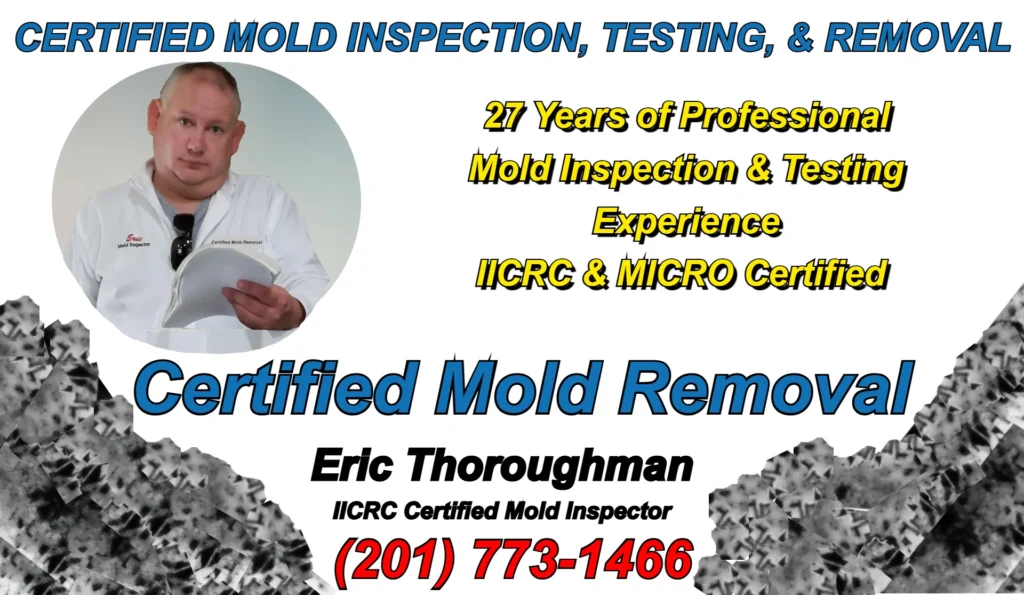
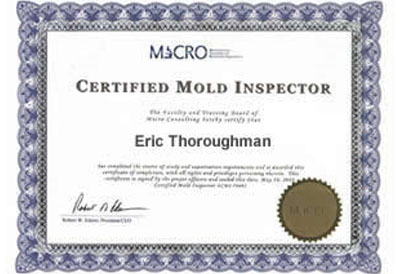
Cresskill, NJ homeowners rely on Eric Thoroughman of Certified Mold Removal for professional mold inspections, certified air quality testing, and written remediation protocols backed by 27 years of expert mold inspection field experience in Bergen County.
Mold Removal for Basement, Bathroom, Kitchen, Garage, Crawl Space, Attic, or Closet
Mold takes hold wherever moisture is allowed to accumulate unchecked. In Cresskill, the combination of older homes, and the borough’s many surrounding waterways creates persistent moisture conditions. These conditions affect every area of a home from the basement floor to the attic rafters.
Basement Mold Removal: Basements are among the most frequent calls we receive from Cresskill property owners. Homes situated near Tenakill Brook, Demarest Brook, or Cresskill Creek face groundwater pressure that intensifies significantly after major storm events. When sump pumps fail during power outages, which is common during nor’easters, basements quickly accumulate standing water. This water intrusion then saturates drywall, framing, and stored contents. Even without visible flooding, hydrostatic pressure through foundation walls and floor cracks sustain enough moisture to fuel mold growth.
Bathroom Mold Removal: Bathrooms in Cresskill’s older homes are frequently affected. Behind old wall and floor tile with grout failure is a common area. Worn grout allowes water to migrate silently into the more porous substrate behind it. Inadequate exhaust ventilation compounds the problem, keeping surface humidity elevated long after showers and baths.
Kitchen Mold Removal: In Kitchens we often find saturated subfloor decking beneath dishwashers and sink basins. Additionally leaky pipes under kitchen sinks that go unnoticed or unaddressed until a musty odor or soft spot in the floor becomes impossible to ignore.
Garage Mold Removal: Garages in Cresskill are particularly vulnerable following storm events, when surface runoff enters through grade-level gaps between slabs and foundation walls. Vehicle condensation and poor perimeter drainage add to the moisture load. These factors and more promote mold growth on drywall, wood framing, and stored contents.
Crawl Space Mold Mitigation: Crawl spaces are especially vulnerable in these older Cresskill homes as moisture management was never a concern during this construction-era. Soil vapor rises continuously into floor joist assemblies where vapor barriers are absent or deteriorated. Post-storm standing water then remains for days in low-lying areas near the borough’s waterway corridors.
Attic Mold Abatement: Attic’s in Cresskill’s cape cods and colonial-style homes are a common area. One major reason is inadequate soffit-to-ridge ventilation. This building deficiency allows warm, moisture-laden interior air to rise into the attic and condense against cold roof sheathing during winter months.
Closet Mold Removal: Closet areas are notorious areas where mold remediation becomes necessary. Exterior-facing walls reflect a common thermal bridging problem in under-insulated wall assemblies. Cold exterior surfaces cause interior humidity to condense inside enclosed spaces with poor air circulation. This produces mold growth that property owners often mistake for dirt or paint discoloration until it has becomes widespread.
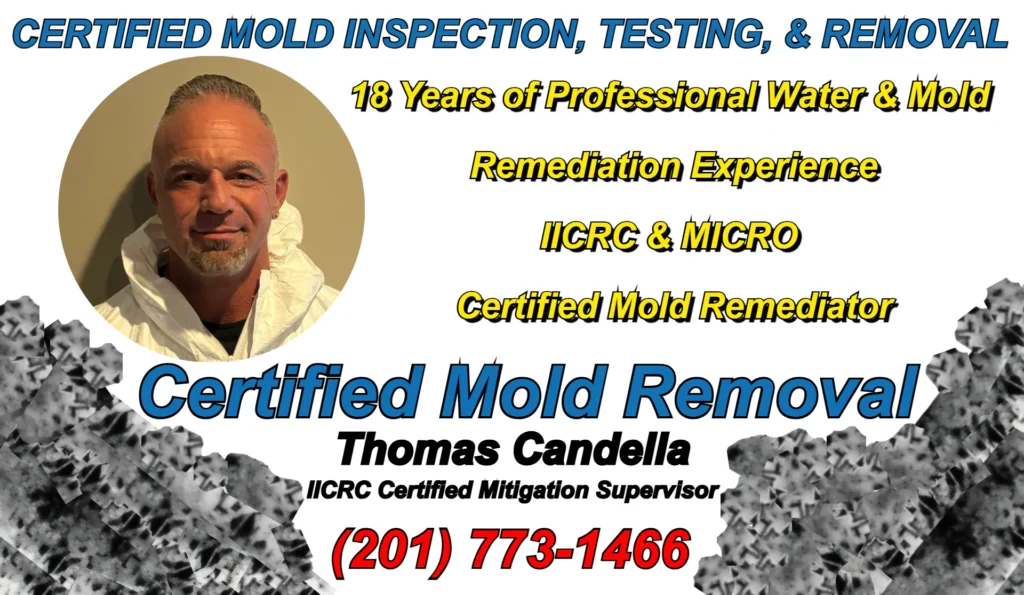
Cresskill, NJ homeowners rely on Thomas Candella of Certified Mold Removal for professional mold removal, certified remediation project supervision, and expert mitigation services backed by 18 years of water and mold remediation field expertise in Bergen County.
Black Mold in Cresskill Homes: What Property Owners Must Know
Stachybotrys chartarum — the species most commonly identified as toxic black mold — demands a very specific set of conditions before it can establish. It colonizes on cellulose-rich building materials such as drywall paper, ceiling tile backing, or wood framing that have been kept continuously wet for a minimum of several days. This means that when black mold is confirmed during a mold inspection, it is virtually always the signature of a chronic, unresolved moisture problem — not a brief or incidental water event.
In Cresskill, the properties most frequently associated with confirmed Stachybotrys findings are those in or near the FEMA-designated flood hazard areas along the borough’s waterway corridors. In these areas, a single flooding event can saturate wall assemblies that are then sealed back up before structural drying is complete. Black mold abatement at Certified Mold Removal is conducted under full negative air pressure containment using HEPA filtration, with physical removal of all affected materials and post-clearance mold testing confirming that the remediation was successful before containment barriers are removed. We do not mask, encapsulate, or paint over confirmed mold growth.
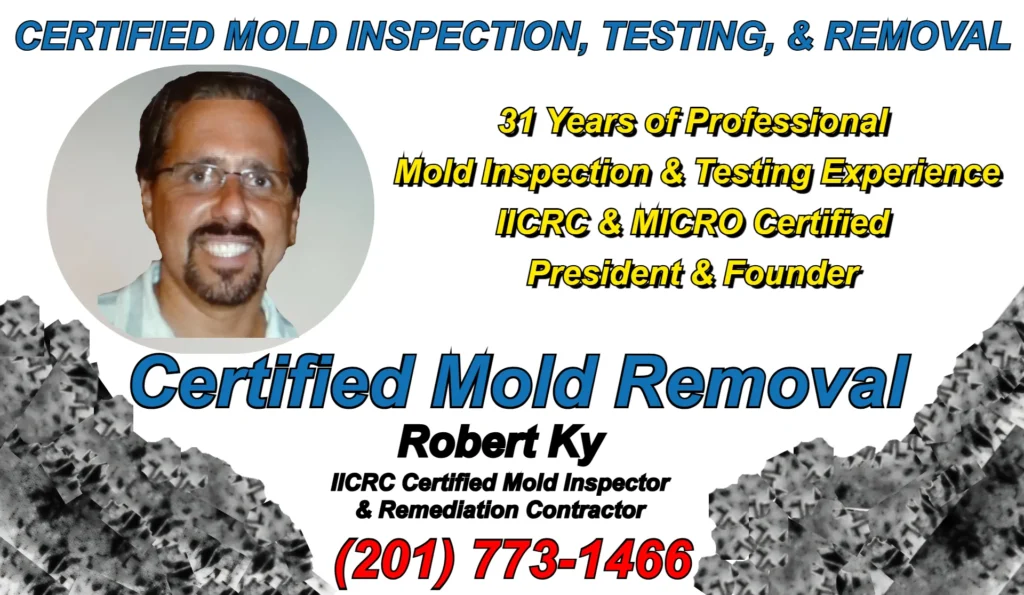
Cresskill, NJ homeowners rely on Robert Ky, IICRC and MICRO certified President and Founder of Certified Mold Removal, for expert mold inspection analysis, testing results interpretation, and comprehensive remediation action plan development backed by 31 years of professional experience in Bergen County.
Why Cresskill Property Owners Choose Certified Mold Removal
FREQUENTLY ASKED QUESTIONS:
Why is mold common in Cresskill residential properties?
Cresskill’s location at the base of the Palisades contributes to unique drainage patterns that can lead to water pooling against residential foundations. In a Cresskill property, moisture frequently migrates through masonry walls or condenses on cool basement surfaces, providing the water necessary for mold to thrive on drywall, wood trim, and organic storage materials.
Can mold grow in the crawl space of my Cresskill home?
Yes. Many properties in this area have crawl spaces that trap ground moisture. Without a professional vapor barrier, this moisture rises and condenses on the wooden floor joists, leading to mold colonization and musty odors that can penetrate the living floors of the residence.
What is the IICRC S520 standard for professional removal?
The IICRC S520 is the industry-recognized benchmark for professional mold removal. Adhering to this protocol ensures that mold is physically extracted under strict containment, using specialized air filtration and cleaning techniques to prevent cross-contamination into clean areas of the home.
What is “HEPA Air Scrubbing” during a mold project?
During remediation, we use industrial-grade HEPA air scrubbers to continuously filter the air within the containment zone. These machines capture 99.97% of airborne spores and particulates, ensuring that the environment remains safe and that contaminants are not spread to other parts of the home during the process.
How much does mold remediation cost for a typical project?
Standard residential services typically start at $2,500. For Cresskill properties requiring extensive basement remediation or structural drying of larger residential layouts, costs generally range from $4,000 to over $20,000.