Certified Mold Removal and Remediation in Denville, NJ
Call (973) 520-6499 For Same Day Mold Testing in Denville, NJ
At Certified Mold Removal, we understand that dealing with a mold problem can feel overwhelming. In Denville, New Jersey, our local weather and water systems create a
natural environment for indoor moisture problems. When a pipe bursts, a roof leaks, or heavy summer humidity builds up, tiny mold spores can quickly settle on building materials. Left alone, these spores grow into colonies that damage drywall, rot wood framing, and ruin ceiling tiles. Fast, professional
mold removal is the most reliable way to eliminate active growth,
protect your investment, and keep your indoor air clean and safe.
Many moisture problems hide deep inside walls or under floorboards where you cannot see them. To fix these issues correctly, you need an accurate diagnostic plan. Scheduling a comprehensive
mold inspection allows a trained specialist to map out hidden moisture and locate the source of a leak. By combining a careful visual inspection with air and surface sampling, property owners get a clear look at their indoor air quality. This detailed
mold testing gives us the information required to design a targeted, safe cleanup plan.
Once laboratory tests confirm a problem, it is time to take action to protect your home or place of business. Professional mold remediation utilizes specialized containment barriers, commercial air scrubbers, and careful cleaning methods to isolate and remove the contamination. This process keeps fine dust and spores from drifting into clean parts of your home or office during the cleanup process.
Robert Ky president of Certified Mold Removal coordinates our inspection and cleanup divisions to deliver a seamless remediation experience.
Certified Mold Removal Inc. Service Links:
Advanced Mold Inspection and Testing Strategies in Denville, NJ
Indoor mold growth does not happen by accident. It is closely tied to local geography, changing weather patterns, regional soil types, and the way our neighborhoods were built. Understanding how these factors interact helps property owners spot trouble before it spreads. To build a successful cleanup plan, an expert mold inspection is essential to map the problem.
Adding mold testing ensures you know exactly what’s in the air you breathe. This lays the groundwork for a successful mold remediation project.
Denville is widely known as the hub of
Morris County because it is built around an extensive network of valleys, lakes, and rivers. The ground beneath our feet consists largely of dense glacial till, gravelly loam, and fine silt soils that naturally hold water. During heavy rainstorms, this wet soil builds up a massive amount of weight and pressure against the foundation walls of your home. This hydrostatic pressure then forces water right through porous concrete blocks and mortar joints, causing a common issue known as foundation sweating. This continuous dampness creates the perfect breeding ground for mold, making professional
mold removal a common necessity.
This underground moisture pressure is intensified by the prominent waterways flowing through our town.
The Rockaway River winds directly through the center of Denville, fed by major branches like Beaver Brook. The borough is also famous for its beautiful lakes, including Indian Lake, Cedar Lake, and Estling Lake. These large bodies of water keep the local water table elevated. When seasonal heavy rains hit, these low-lying water systems fill up fast, causing groundwater to rise beneath your foundation. This rising water frequently finds its way into your basement or an unlined crawl space. This requires consistent monitoring, professional mold testing, and expert water mitigation to prevent damage.
Our northern New Jersey climate also plays a major role in indoor humidity. Denville experiences humid summers with heavy year-round rainfall. According to recent data from the Rutgers New Jersey Climate Resource Center, our region is seeing a steady increase in intense storms and extended summer heat waves. When outdoor humidity stays above 60% for several consecutive days, your home absorbs this moisture. This is when a timely mold inspection is so valuable for property owners.
Summer weather also creates a hidden moisture trap inside the walls of your home. When hot, humid outdoor air forces its way in, it quickly hits cool, air-conditioned interior wall surfaces. This temperature drop causes moisture to form inside your wall cavities. This hidden moisture feeds dormant fungal spores, which eventually requires professional
mold remediation to clean up safely.
If you notice a musty odor during the summer, mold testing can reveal if hidden growth is spreading behind your walls.
The style and age of your home also dictates its vulnerability to environmental issues. Denville features an eclectic mix of historic downtown retail blocks, mid-century lakefront cabins, and modern corporate buildings. Each construction type has its own distinct weak spots:
-
- Historic Downtown Buildings: Many older buildings downtown were built with stone foundations and heavy wood frames. Over the decades, old lime mortar can wash away from soil acidity, creating tiny gaps that let water seep behind interior plaster walls. Finding these hidden leaks requires a specialized mold inspection.
- Lake Community Cabins: Over time, homes originally built as seasonal summer cabins around our local lakes have been converted into year-round residences. These properties have low crawl space foundations with open dirt floors. An unlined dirt floor allows moisture to rise. This moisture then settles on floor joists, causing growth which requires mold removal services.
- Modern Energy-Efficient Homes: Newer residential homes are designed to be airtight to save on heating and cooling bills. However, if a kitchen appliance overflows or a bathroom exhaust fan breaks, that moisture stays trapped inside the walls. This trapped dampness causes rapid fungal growth that requires full-scale mold remediation to correct.
- Commercial Real Estate: Flat roofs on commercial corridors like Route 10 and Route 53 are highly prone to pooling water and flashing leaks over time. When water gets in, it often pools unnoticed, creating the need for mold removal services.
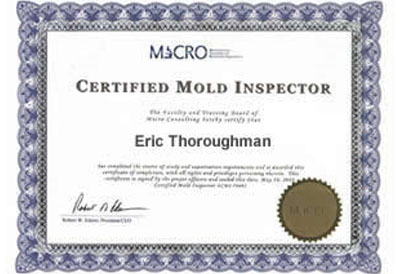
Detailed property diagnostics and expert mold testing services in Denville, NJ are managed on-site by IICRC certified inspection expert Eric Thoroughman.
Denville Mold Removal and Remediation Services
Room-by-Room Guide: Common Areas Where Mold Removal Becomes Necessary
Mold is highly adaptable, but it cannot grow without a water source. By understanding how moisture behaves in different areas of your home, you can find problems before they get out of hand. If you suspect an issue in any of these places,
a professional mold inspection is the safest way to address the problem.
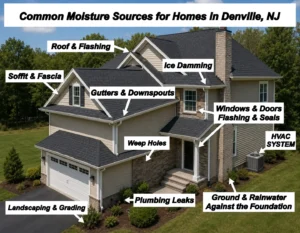
Your inspector will locate exterior water issues so we can block off the area before starting any physical mold removal services in your Denville, NJ home.
Rooms that use a lot of water, like a bathroom or kitchen, face problems such as plumbing leaks and high humidity. In a bathroom, broken or weak exhaust fans fail to remove humidity from showering. This causes dark spots to form on your ceilings and on the tile grout.
In your kitchen, hidden leaks under your sink, behind the dishwasher, or around the refrigerator can rot cabinetry backing for months before anyone notices.
Laundry areas face similar risks from cracked washing machine hoses or clogged dryer ducts. Professional mold abatement involves fixing the plumbing, removing ruined materials, and cleaning the area thoroughly. If you are worried about spores spreading to nearby rooms, scheduling diagnostic mold testing can help us fix this.
Stagnant utility and storage areas like your garage, attic, or closet are highly prone to mold because they lack proper airflow.
In an attic, roof leaks, old flashing around chimneys, or winter ice dams trap water against plywood roof sheathing. In your garage, uninsulated garage doors and bare concrete floors collect heavy condensation during spring and autumn weather shifts. This damages drywall and stored cardboard boxes.
A tightly packed bedroom closet can trap stagnant air against a cold exterior wall. This causes spores to grow on clothing and shoes. Our experienced inspectors use advanced mold testing to check air quality in these enclosed spaces, ensuring your home is returned to a safe and healthy living environment.
Toxic Black Mold Protocols: Safe Mold Inspection, Testing, and Removal
Among indoor environmental hazards,
Stachybotrys chartarum—commonly known as toxic black mold—requires specialized care and strict safety containment. This dark greenish-black organism thrives on building materials with a high cellulose content and low nitrogen levels, such as drywall, wood, and wallpaper backing. Unlike common household molds, black mold needs to be constantly soaked with water to grow. Professional
mold testing is used to confirm whether this specific strain is present in your home, while a detailed mold inspection maps out exactly how far the growth has spread.
Because black mold spores are heavy and sticky, they do not become airborne easily unless the material dries out or is physically disturbed. This is why a well-performed
mold inspection is so critical. If an untrained person or a
general contractor tries to scrape, cut, or tear down dry black mold without professional containment, millions of particles can launch into the air. This ends up cross-contaminating your entire home. Professional
mold removal requires isolation barriers and safety equipment to complete this work without spreading the problem to clean rooms.
According to global public health studies published by the
World Health Organization Indoor Air Quality Guidelines, living or working in damp, contaminated environments poses real health risks. Black mold produces organic compounds known as mycotoxins. Breathing in these particles over time can trigger a variety of health symptoms including:
- Chronic coughing, wheezing, and sinus irritation.
- Severe eye irritation, skin rashes, and raw sore throats.
- More frequent asthma attacks and respiratory issues.
- Persistent headaches and fatigue from long-term exposure.
- Increased vulnerability for individuals with pre-existing respiratory conditions, children, and the elderly.
Safely resolving these hazards requires professional mold removal. Technicians build plastic isolation barriers, run negative-pressure air scrubbers equipped with certified HEPA filtration, and use specialized safety gear to remove the affected materials without spreading contamination. Following these strict steps, comprehensive mold remediation ensures your home or office is thoroughly cleaned, sanitized, and safe.
Our advanced mold remediation protocols for Denville, NJ homeowners are safely executed by Thomas Candella, MICRO & IICRC certified cleanup specialist.
Why Choose Our Company: Certified Mold Removal
Protecting your property value and indoor air quality requires working with a certified local specialist. Certified Mold Removal provides expert, reliable care tailored to your exact building needs. We combine decades of experience with advanced training to ensure your property is correctly remediated.
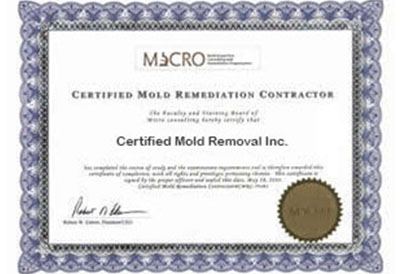
Our mold remediation crew members hold comprehensive certifications from the Institute of Inspection Cleaning and Restoration Certification (IICRC), including Applied Microbial Remediation Specialist credentials. We follow the industry-accepted ANSI/IICRC S520 Standard for Professional Mold Remediation, ensuring every cleanup step is safe, structured, and legally compliant. Through careful execution, our professional mold removal processes are the most detailed available. Complete mold remediation along with testing guarantees peace of mind.
We protect your property with
full environmental insurance, including specialized pollution liability coverage. Every air and surface sample test we collect during a
mold inspection is processed by independent, third-party laboratories accredited by the American Industrial Hygiene Association (AIHA). We provide detailed moisture maps, clear photo documentation, and a structured cleanup plan tailored to your property. When finished, certified
mold testing validates our results.
To read reviews from local homeowners and view our recent projects across Morris County,
visit our official business listing on the Google Business Profile Platform. We provide clear communication, outstanding customer service, and reliable property care throughout our Morris County community. Our local reputation is built on delivering high-quality environmental results that keep local homes and businesses safe. Choose us for professional mold removal solutions.
Schedule Your Professional Mold Assessment in Denville, NJ Today
Our certified experts are available to discuss your specific situation, review laboratory results, or provide a detailed remediation plan tailored to the specifics of your home or business. Call our local mold testing and inspection specialists today to protect your property and peace of mind.
- Office Dispatch Phone: (201) 773-1499
- Service Hours: Emergency Response Available 24/7
- Regional Coverage: Denville, Rockaway, Dover, Morris Plains, and surrounding Morris County neighborhoods.
Frequently Asked Questions
What is considered a “safe level” of mold in my Denville, NJ home?
No federal standards exist defining “safe” mold levels. However, reactions vary dramatically based on sensitivity and health factors. Some only experience mild allergies, while others face health complications. Our team eliminates all visible mold and reduces airborne spores to natural outdoor levels, creating a healthier environment.
What questions should you ask before hiring a mold professional?
Ask about experience, licensing, insurance coverage, remediation processes, safety protocols, and warranty offerings. Our team answers all inquiries transparently, providing credentials and references to demonstrate our expertise in comprehensive residential and commercial mold removal. You can trust us to deliver results.
How do I minimize risk to other home occupants during mold removal or remediation?
Avoid remediation areas if you are sensitive to mold. We also seal HVAC vents, establish containment barriers using sheeting, and maintain negative pressure during larger projects. Our team implements strict containment protocols preventing cross-contamination, so you and your family are protected throughout the process.
Will painting over mold solve the problem?
No, paint doesn’t stop mold growth without fixing moisture sources. Mold feeds on paint’s organic content and underlying materials like drywall paper. Invisible spores remain active beneath paint. Our team addresses root causes to ensure mold won’t return after remediation.
How do I know if my Denville, NJ home has a mold or moisture problem?
Look for water stains, discoloration, warped floors, peeling paint, rotting wood, condensation, or musty smells. We often find hidden mold behind wallpaper, furniture, baseboards, or within structural cavities. Health symptoms indoors also indicate problems. Our local Denville, NJ mold inspection team will locate all contamination sources.
How do I prepare for a mold inspection?
Ensure access to basements, attics, and crawl spaces. If you have any furniture or clutter in these areas, clear them out. Also, document visible problems, water damage history, and health symptoms. We bring specialized detection equipment for thorough contamination assessment and evaluation.
How long to stay out of the house after mold remediation?
Wait 24-48 hours at the very least. Extensive projects need longer, though, to ensure everything is completely dry. That eliminates airborne spores or chemical residues. Our team provides timelines based on your project’s scope, so that you can return to a mold-free home.