A musty odor after a leak, staining around a vent, or recurring allergy symptoms indoors can put you on alert fast. In those moments, homeowners and property managers usually ask the same question: what are the best mold testing methods, and which one gives a reliable answer without wasting time or money?
The honest answer is that no single test is best in every situation. Proper mold diagnosis depends on what you are seeing, what the building has been through, and what decision needs to be made next. A small visible patch in a bathroom does not call for the same testing approach as a school office with chronic humidity complaints or a home with hidden moisture behind walls. Good testing is not about creating fear. It is about identifying whether mold is present, where it is coming from, how far it has spread, and what evidence is needed to support safe cleanup.
What makes mold testing useful
Testing should answer a practical question. Is there active growth? Is indoor air being affected? Is the contamination limited to one area or spreading through connected spaces? If testing cannot help guide scope, containment, or source correction, it may not be necessary.
That is why experienced inspectors start with the building, not the lab form. Moisture mapping, visual inspection, and occupancy history matter just as much as the sample itself. A lab result without context can be misleading. Mold spores exist in normal outdoor air, and some indoor detection is not automatically a crisis. The goal is to compare conditions, identify patterns, and decide whether remediation is warranted.
Best mold testing methods for different situations
Air sampling
Air sampling is one of the most requested methods because people want to know what they are breathing. It can be valuable when there is a musty odor, health complaints indoors, suspected hidden growth, or a need to compare indoor air to outdoor baseline conditions.
The strength of air testing is that it can detect elevated spore levels even when mold is not visible. It is especially helpful in offices, finished basements, attics, and occupied homes where contamination may be concealed in wall cavities, ceiling spaces, or HVAC-related areas.
The trade-off is that air testing captures a moment in time. Spore counts can shift with weather, HVAC operation, foot traffic, open windows, and recent cleaning. That means air sampling works best when it is part of a controlled inspection process, not a standalone shortcut. Done correctly, it is a strong tool. Done casually, it can produce noise instead of clarity.
Surface sampling
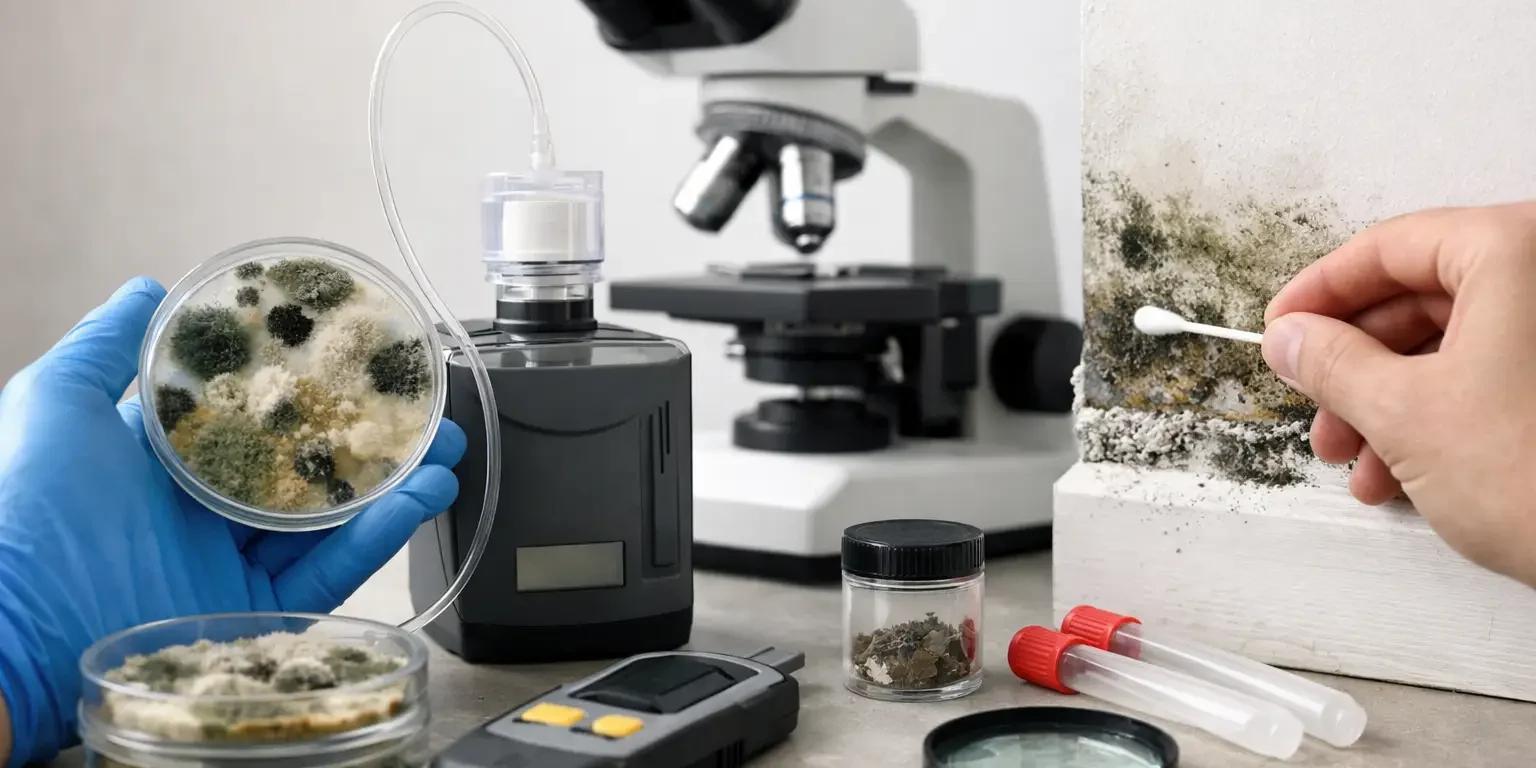
Surface sampling includes swab, tape lift, or bulk sampling from visible suspect material. This method helps confirm whether a stain or residue is actually mold and can identify the type of fungal growth present on a surface.
This is often useful when there is visible discoloration but uncertainty about what it is. Dust, soot, old water marks, and general staining can all be mistaken for mold. Surface testing can also support remediation planning by confirming contamination on building materials, contents, or HVAC components.
Its limitation is straightforward. Surface sampling tells you what is on that specific area sampled. It does not tell you whether the rest of the room, the air, or the hidden side of the wall is affected. It is precise, but narrow.
Bulk sampling
Bulk sampling involves removing a piece of material, such as drywall, insulation, carpet, or wood, and sending it to a lab. This method can be useful when materials are already damaged, being removed anyway, or need closer analysis.
Bulk samples often provide strong confirmation of embedded growth inside porous materials. If drywall has been wet repeatedly or subflooring shows suspicious damage, bulk sampling can help determine whether contamination is superficial or established within the material.
Because it is destructive, even on a small scale, it should be used selectively. In many cases, visual evidence plus moisture history already tells an experienced professional that the material is compromised. Testing should support the decision, not delay it.
Cavity sampling
When mold is suspected behind walls, above ceilings, or inside enclosed chases, cavity sampling can be one of the best mold testing methods available. Inspectors access the hidden space through a small opening and collect air or material samples from inside the cavity.
This method is valuable after roof leaks, plumbing failures, window intrusion, or long-term condensation problems where the visible finished surface looks mostly intact. It can confirm hidden contamination without opening up large sections of the building prematurely.
The key here is judgment. Cavity sampling should be paired with moisture readings and a clear understanding of the building assembly. Otherwise, it risks becoming a fishing expedition.
ERMI and dust-based testing
ERMI and other dust-based DNA testing methods analyze settled dust for mold-related species. These tests are sometimes used when occupants want a broader picture of long-term mold conditions rather than a snapshot of one day.
They can be helpful in cases involving chronic water damage history, post-remediation disputes, or situations where occupants suspect an ongoing problem despite inconsistent air sampling. Because dust accumulates over time, it may reflect patterns that short-duration air samples miss.
Still, these methods need careful interpretation. Dust can include old contamination, outdoor carry-in, or residue from conditions that are no longer active. A high score does not automatically mean there is current growth that requires removal. It may mean the building needs a deeper investigation. This is where certified interpretation matters.
Moisture mapping and thermal imaging
Strictly speaking, these are not mold tests. But in real-world inspection work, they are essential diagnostic methods because mold follows moisture. A moisture meter can identify wet drywall, elevated readings in trim, damp subflooring, or hidden migration from plumbing and roofing issues. Thermal imaging can help locate suspicious temperature differences that suggest trapped moisture.
These tools do not identify mold species, and they cannot replace lab analysis when documentation is needed. What they do exceptionally well is locate the conditions that support growth. In many projects, this is the difference between solving the problem and merely cleaning the symptom.
Visual inspection with building history
This is the method people tend to undervalue, even though it often determines whether every other test is used correctly. A certified inspector looks at water intrusion patterns, humidity levels, construction details, ventilation, material condition, and occupant complaints. That context guides where and how samples should be taken.
An inspection-only approach may be enough when mold is visible, the moisture source is obvious, and the remediation scope is clear. Not every project needs extensive lab testing. In fact, oversampling can add cost without improving the plan. The best outcome comes from matching the method to the problem.
When one method is not enough
Complex cases usually call for more than one approach. A property manager dealing with tenant complaints and no visible mold may need air sampling, moisture mapping, and targeted cavity testing. A homeowner after a basement flood may need visual inspection plus surface or bulk confirmation if materials are questionable. A commercial building with recurring odors may require HVAC-focused inspection with selective air and surface sampling.
This layered approach reduces guesswork. It also helps avoid the two most common mistakes: assuming every stain is dangerous mold, or assuming hidden mold is not present just because one simple test came back low.
How to judge whether test results are credible
The quality of mold testing depends heavily on who performs it. A credible evaluation should explain why a sample is being taken, what comparison points are being used, and how results affect next steps. If an inspector jumps straight to expensive remediation based on vague language or fear, that is a red flag.
Reliable testing should connect the lab data to the building conditions. It should answer practical questions about source correction, containment, material removal, and post-cleaning verification if needed. That is especially important in occupied homes and businesses, where indoor air protection is part of the job, not an afterthought.
For property owners in moisture-prone regions like New Jersey and the surrounding Northeast, speed matters, but speed without accuracy can create a second problem. Certified Mold Removal Inc. approaches testing as the first phase of proper diagnosis, with the goal of identifying the source, defining the scope, and protecting occupants throughout the process.
Which testing method is best for your property?
If mold is visible and the moisture source is obvious, a professional inspection may be enough to move directly into remediation planning. If there is odor, health concern, or suspected hidden growth, air sampling and moisture investigation are often the strongest combination. If a specific stain or material needs confirmation, surface or bulk sampling may be the better choice. If the concern is inside a wall or ceiling, cavity sampling can provide the missing evidence without unnecessary demolition.
The right answer depends on the building, the damage history, and the decision in front of you. The safest move is not choosing a test from a list. It is getting a disciplined inspection that uses the right method for the right reason, so the problem gets solved at the source and the indoor environment can return to normal.